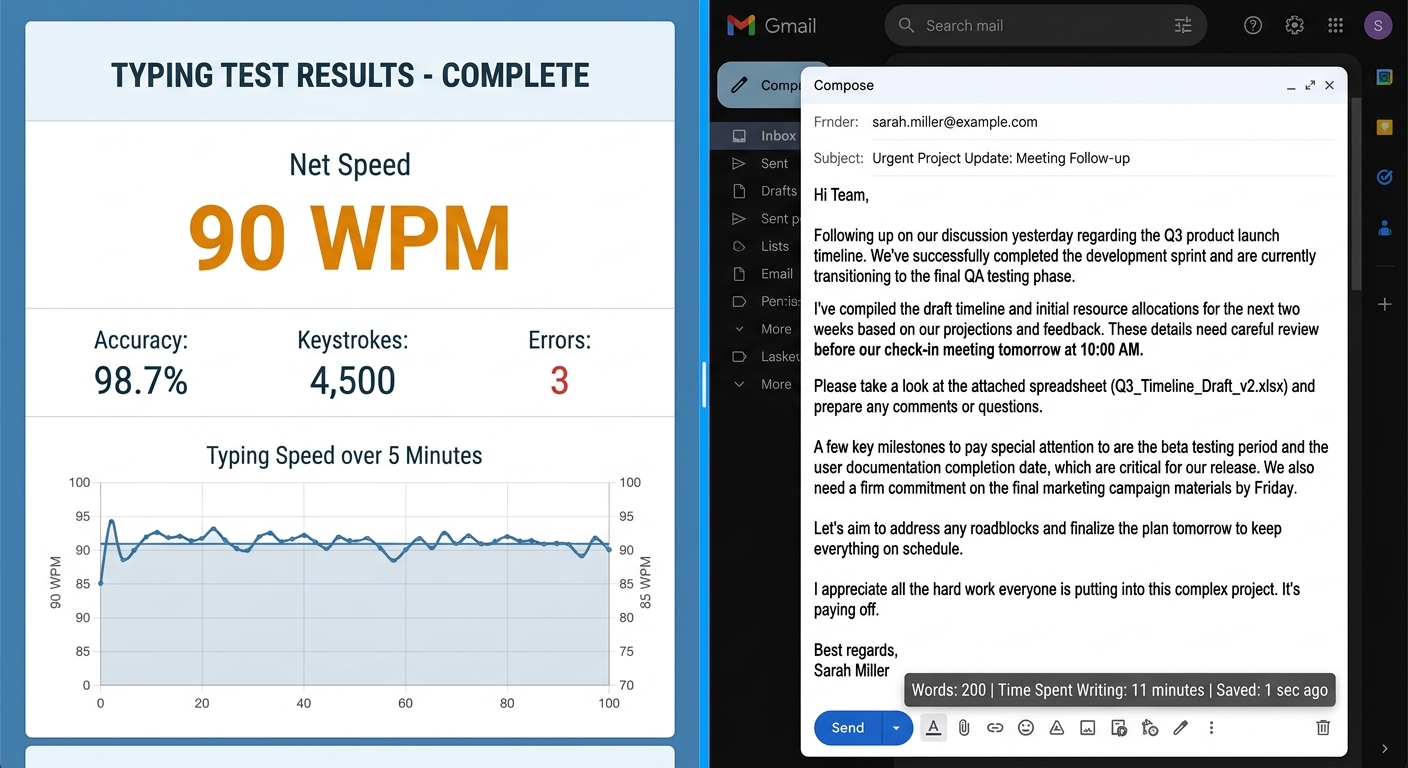
I used to believe that I was a pretty good typist. I used to be around 95 for my WPM with Typing Battles. Not as quick as it could be, but decent.
I then attempted to do an alphabet typing test. A to Z. That's it. A mere series of 26 letters in a row.
I have all of them for the most part, but I faltered on K and slowed down at Q and I stopped at Z.
Apparently I created efficient highways for common letters, such as E, T, and A. The back streets, however, (the lettered streets X, V, and Z) were unpaved, muddy, and forgotten.
This article is for those that want to know why that basic test is as important as you think.
What Is An Alphabet Typing Test?
So, the definition without all the "noise.
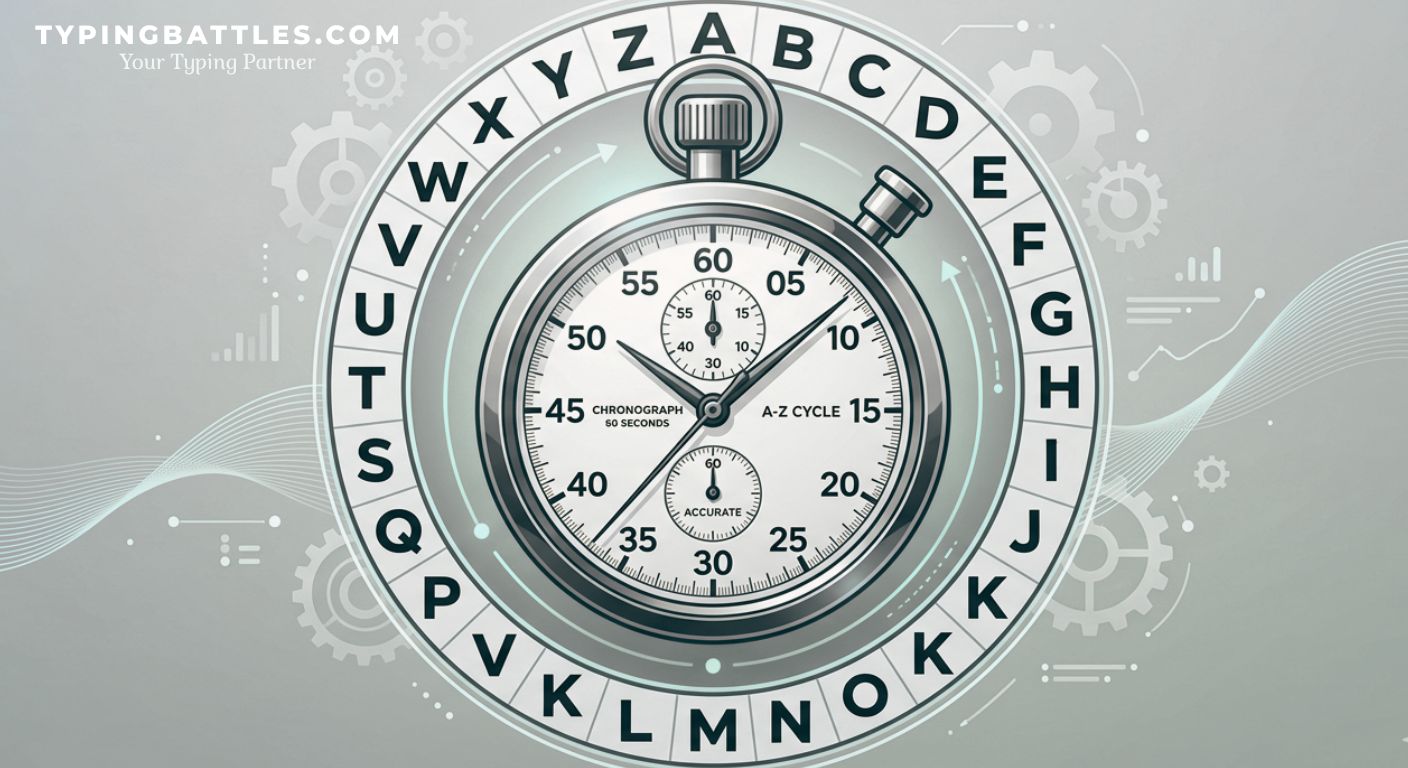
Alphabet typing test is a typing test that requires you to type the alphabet sequentially as fast as you can and correctly – A, B, C… all the way to Z.
That's it. No sentences. No punctuation. No numbers. Only 26 consecutive letters in a row.
Several variations are based on pangrams (sentences that contain all the letters such as the quick brown fox jumps over the lazy dog). There is, however, one pure version: the ABCs.
The alphabet test isn't like a traditional typing test, where the words you get are common English words, but it's more of a test of your ability to find each letter on the keyboard without hesitation.
How It Is Different From A Typical Typing Test.
A normal typing test will cover up your weaknesses. You will be typing lots of words such as 'the', 'and', 'you' and so on. All common letters get the practice. In the meantime, you may not type a single Q, X or Z in an entire test.
The alphabet test insists you face those keys that you've forgotten about.
The first time I attempted to do it I remember. I did a fast run of A to G. Then H, I, J, K, L, M, N, O, P were fine. But Q? My pinky was frozen on my left hand. I had to think. I had to look down.
The hesitation gave me just what I needed to practice.
Why Alphabet Typing Tests Are Important?
This is the hard reality. Your fingers have favorites! They love E, T, A, O, I, N, S. They are deathly afraid of Q, Z, X, V and B.
The alphabet test reveals that bias.
Develops A Mental Map Of The Keyboard
As you start to learn to touch type, your brain must develop a mental image of the location of each key. Full sentences allow you to make mistakes and use context to guess.
That crutch is removed when you type the alphabet. It's just letters. No patterns. No predictions. You either know the key, or you don't.
It used to take me 5 minutes a day to type a to z slowly, while blindfolded. I didn't think about key positions for 2 weeks. It went away with a single flick of my fingers.
Reveals Your "Blind Spots"
All typists have poor typing spots. There are some letters that they look for easily without looking. These will show up clearly with the alphabet test.
At J, if you pause; at K, if you stumble; at B, if you find; you've found just what you need to improve. This is because that kind of feedback is more difficult to obtain from paragraph-based tests that feature rare letters.
For me, it was K, X, and Z. A week I spent to drill those letters by themselves. I had a 2.5 second decrease in my alphabet test time.
Quick Skill Benchmark
The alphabet speed test gives you a quick overview of your typing skills. You know your time because it's a clear, objective measure of improvement.
2 seconds is a real improvement in your WPM score, regardless of the number of words per minute – you've actually enhanced your knowledge of the keyboard.
That was the immediate reinforcement that held me on when I felt the typing tests weren't moving fast enough.
The Appearance Of A Good Alphabet Typing Test
Not all alphabet tests are created equal. Here are three formats that I found useful.
Sequential A–Z Typing Is A Simple And Easy To Use Solution
It's the original recipe. Open a text box. Without looking down, write the word "abcdefghijklmnopqrstuvwxyz". Your speed is monitored by a timer. Most platforms also record accuracy; any missed or wrong letters will be marked.
This format is great because it is easy. No distractions. No judgment. It's you and your keyboard and the ABCs.
Pangrams
A pangram is a sentence which uses all the letters of the alphabet at least once. This is the most popular, known as "the quick brown fox jumps over the lazy dog.
A Pangram test is more complex than a pure sequential typing. They require you to type each letter, but this is in a more realistic setting. Your fingers should move from one letter to another in a natural sequence, and not alphabetically.
I did both sequential and Pangram tests. I learned about keys from Sequential. They were used with Pangrams to help me with real typing flow.
Reverse Alphabet Typing
This one was a brain twister. Z, Y, X, W, V, U, T, S, R, Q, P, O, N, M, L, K, J, I, H, G, F, E, D, C, B, A.
By typing the alphabet backward, your brain is forced to work in a different way. The usual rhythm of A to Z will not work, because you must remember each key's location.
It's uncomfortable. That's the point.
My Experience Of The Alphabet Typing Tests
I started testing my children with alphabet tests every day for a month.I started daily alphabet tests for a month. Here's what happened.
Week one: Frustration. I had a time of 9.8 seconds. I continue to struggle at K, X and Z. I had to take my dog's head down at least three times a run.
Week two: Improvement. I learned to memorize the problem keys. My time was reduced to 7.2 seconds. No more blinks of the eyes.
Week three: Flow. I began to type the alphabet randomly. I couldn't help but move my fingers. The time decreased to 5.8 seconds.
Week four: Confidence. Added reverse alphabet. That was the new fight, my forward time went up to 5.1 seconds.
But more importantly, I've gone from 95 WPM to 103 WPM. My accuracy went from 94% to 97%.
I didn't get any faster through the alphabet test. However, it has cured the cracks in the foundation of my home. If the house is built on a solid foundation, the remaining parts are elevated.
Speed Benchmarks
I have compared my results to other typists and found the following:
When attempting this challenge for the first time, most beginning learners do the ABCs in 8-15 seconds.
Given the right effort and technique, intermediate typists will hit the 5-7 seconds mark.
Person with a high level of typing skill and who has internalized all of the key positions can finish the test in 3-5 seconds.
Anyone who has been typing for years at an expert level will be able to get to under 3 seconds. The best times I've seen are around 1.5 - 2.5 seconds.
If you're not a professional runner, then don't pursue those elite times. For most, a 6 seconds or less is a reasonable benchmark and represents a high level of keyboard knowledge.
What You Must Do To Practice Alphabet Typing
This is the schedule that worked for me. No magic. Just consistency.
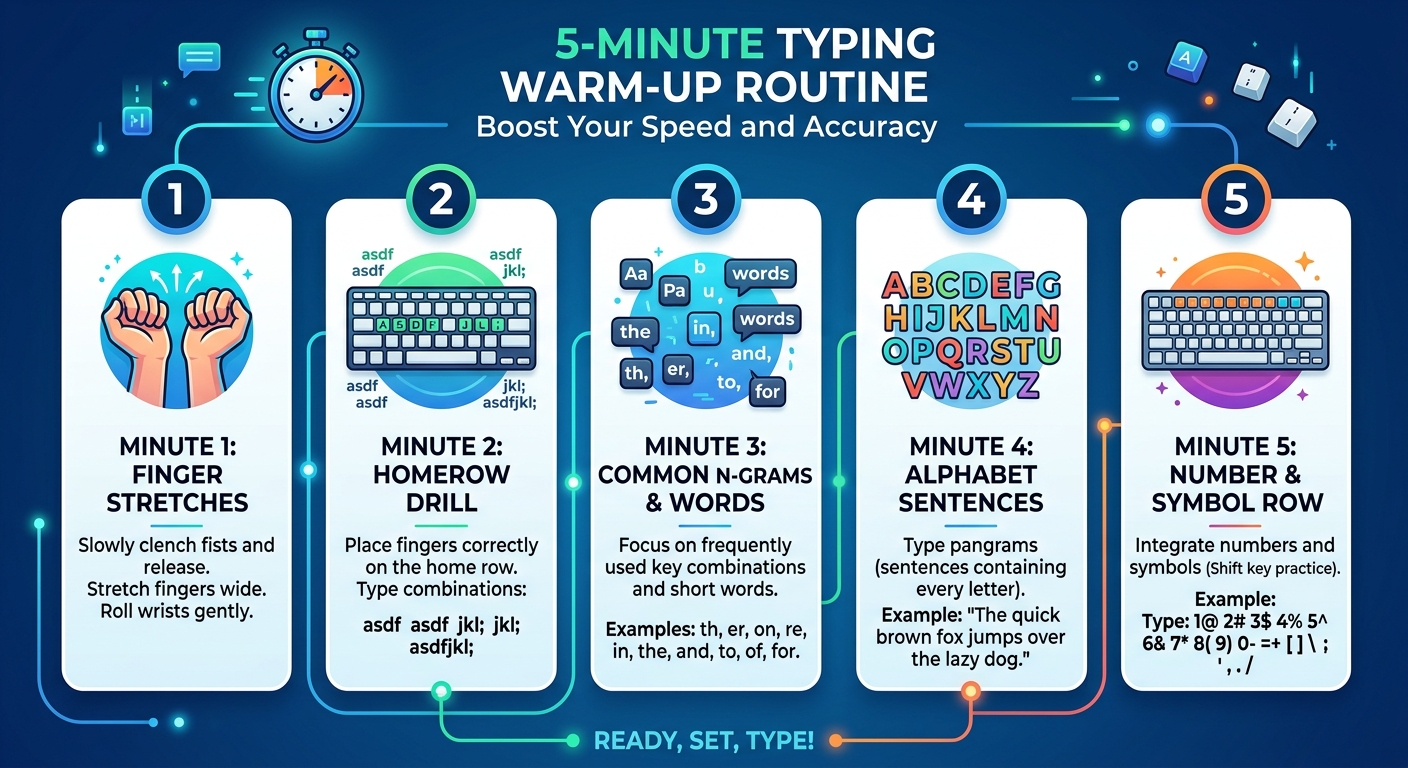
Begin at home position. All efficient typing starts off with A, S, D, F and J, K, L, semicolon. Type each letter and return fingers to home row. This is developing the muscle memory to come back to neutral.
Use a timer. You must NOT simply write the alphabet spontaneously. Time yourself. Your brain has to stop overthinking because of the time pressure!
Don't look down. This is the most difficult rule. Looking over the shoulder, doesn't make the test any easier. The alphabet test is a diagnostic test. The diagnosis is rarely visible when looked down, and is often hidden.
Track your progress. Record the time following each attempt. With the numbers going down, even by .1 seconds, I think that kept me going.
Add reverse alphabet 1x a week. A different challenge which reinforces the same neural connections in a different way.
A‑Z Typing And Typingbattles Races
You may well ask yourself, why the alphabet tests and not just race on TypingBattles?
Here's my take.
Typing Battles are true to their name. Everything they test – speed, accuracy, endurance, mental composure. There's nothing like facing your opponent in person.
Races are brief though. Usually 30‑60 seconds. They employ true sentences, meaning the common letters are prevalent.
The alphabet test is filling the gap. It's a concentrated drill that concentrates on your poorest keys.
Just as you would prepare for a sport, think of it as preparation for this sport. Scrimmages (races) are required. However, you must also have isolated drills (alphabet tests). When you combine the two, you've got a full-fledged typist.
The Most Frequent Errors And Their Respective Remedies
Mistake One: When using just one or two fingers. You're not going to develop strong muscle memory if you are looking for words by trial and error. Shop: Make sure you use the right finger on each key. Q, A, and Z are owned by the left pinky. Use it.
Mistake Two: Failing to keep up the pace without losing accuracy. It is not worth having if you don't have a fast time with typos. If you type "abcdeft..." instead of "abcdefg...", you're missing a letter! Slow down. Get it right. Speed will follow.
Mistake Three: Viewing the keyboard. As I've said before. It's worth repeating. If you need to, cover hands with a towel. A cheat is no help to the alphabet test.
Mistake Four: Only practising the forward alphabet. Mix in reverse. Mix in pangrams. Don't let your mind settle on any one thing.
The Bottom Line
You will not become a typing speed demon after taking the alphabet typing test. It's not glamorous. It's not a game.
It's a hard look in a mirror. It tells you where your fingers go numb, where your memory is weak and where your muscle memory is lacking.
I still use it as warm up before TypingBattles races. I have one run, from A to Z and I know where everything is.
Try it for a week. Time yourself. Count down from 60 seconds. Then take that newfound confidence to the racetrack.
Key Takeaways
- An alphabet typing test is a test for typing the alphabet a to z in the right order and no more.
- It reveals weak keys that are not revealed with normal typing tests (Q, X, Z etc.).
- Beginners take 8-15 seconds, intermediate take 5-7 seconds, and advanced take less than 5 seconds.
- The test creates a mental map of the keyboard without using word patterns.
- For pre-race warm up before TypingBattles races, use it as a warm up.
- Include reverse alphabet and pangrams for variety and in-depth learning.
- Don't look down. The actual value of the test lies only if you're honest about your blind spots.
Author Bio
Abid is a competitive typist on TypingBattles (105 WPM, 400+ wins). He ignored alphabet tests for years, thinking they were too simple. Then he tried one and discovered his fingers were ignoring four letters entirely. Now he uses A‑to‑Z drills every morning. His wife thinks the constant "abcdefghijklmnopqrstuvwxyz" muttering is weird. She's not wrong.
Recommendation
Before you queue up for another race, take 10 seconds. Type the alphabet. Find your weak spots. Fix them.
Then bring that sharper, more complete keyboard knowledge back to the racetrack.
Take an alphabet typing test now →
Read Also:
- Which Is The Best Typing Test: 1 Minute, 3 Minute Or 5 Minute Typing Test?
- Typing Nitro Hack vs Eye Gaze Typing: Cheaters Never Win, But Eye Gaze Typing Changes Lives
- Typing Dinosaur vs Typing Bike, Which Game Improves Typing WPM?
- Keyboard Clicker: I Added Fake Clicks to My Silent Keyboard – Here's How It Went
- Gaming Keyboard and Mouse: I Read 100+ Reddit Threads So You Don't Have To