I can still recall the day I reached 60WPM for the first time.
It was like I was a rockstar. I said to myself, "That's it, I am fast, no one can beat me.
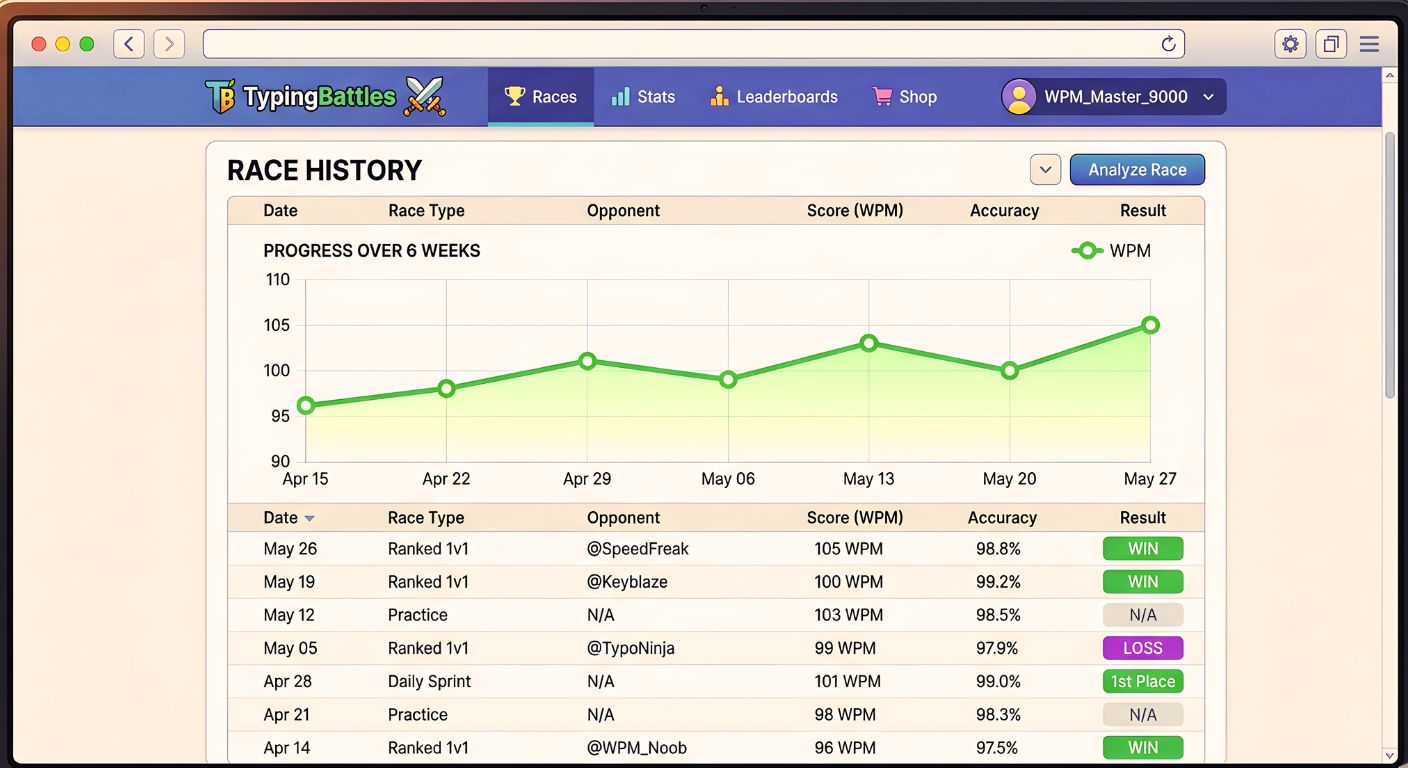
Then I got on TypingBattles and got smacked with a 110 WPM guy.
So I asked around. I read forums. I took tests. And I discovered the notion of "good typing speed".
It depends on who you ask, but this is a question that should be addressed. A data entry manager does not require different numbers than a novelist. A novice will have other criteria than a competitive racer.
Don't get confused, let me save you. The true definition of a good typing speed in different contexts.
The Short Answer (If You're Just Looking For Numbers)
Let's get the basics first and then talk about the details.
- 20 words per minute - WPM: Very slow. You may be continuing to search and peck. It will be difficult for you to do any type of typing job.
- 20 to 30 words per minute - WPM: Slow but adequate. Basic computer functions can be accomplished. Emails will take a while.
- 30-40 words per minute - WPM: Average of casual typists. This is a common area for office workers to fall into. You may not be fast, but you get by.
- 40‑50 words per minute - WPM: Solid. Most people don't continue to get better in the natural way past this point. Useful for most applications.
- 50‑60 words per minute - WPM: Above average. You're quicker than many of your co-workers! You might be looked at for data entry positions.
- 60‑70 words per minute - WPM: Fast. You're in the top 20‑30% of general typists. Transcription jobs start here.
- 70‑80 words per minute - WPM: Very fast. This is work territory. Court reporters? No. But administrative roles? Yes.
- 80‑90 words per minute - WPM: Excellent. You are quicker than 90% of people. Competitive typing is possible.
- 90-100 words per minute - WPM: Elite – for normal typists. You might be able to enter into amateur races.
- 100+ words per minute - WPM: Exceptional. This is a competitive area. This is something that only a small number of typists ever get to.
But these numbers don't tell the whole story. Let me explain.
What "Good" Means In Various Circumstances
That's where things get complicated.
For Beginner Learning Touch Typing
If you are just starting, and you're still staring at the keyboard, then 25 WPM is a success. Seriously. Stop the looking habit—don't hit high speeds.
I recall the time I was a little one when I put a towel on my hands. I slowed down to 12 wpm. I felt like a dork. Then, in two weeks, I was up to 30 words per minute, unaided.
To the beginning user, good is above 20 WPM, without looking. Speed comes later.
When A Student Taking Notes During Class
You need to keep up with a teacher speaking at about 100‑150 words per minute. However, you cannot type all of the words. It's necessary to summarize.
With good shorthand skills, most students are able to take notes at 40-50 WPM. However, if you wish to type at the same speed as you speak? You need 80+ WPM.
For An Office Worker Or Administrative Assistant
The real answer to jobs that you won't find in an ad. They tend to require 40-50 WPM. Typical hiring managers will be satisfied with 35 WPM as long as it's accurate.
Why? Most working in an office involves thinking. You do not have to contend with typing constantly. You're composing e-mails, completing forms and clicking a mouse.
However, for anything to be noticed, a speed of 50 to 60 WPM and 95% accuracy is a good rate.
For Data Entry Or Transcriptionist
These positions are unique. You're typing constantly. Your earnings are directly related to your speed.
Typing 50-60 words per minute is common for entry level data entry jobs. Of the higher-paying medical transcription jobs, they may require 75-85 word per minute transcription with very high accuracy.
One of the transcriptionists said to me that "if you can manage 60 WPM, you'll be earning $15 an hour, and if you can get up to 90 WPM, you'll be earning $25 an hour. The math is brutal.
For A Blogger Or A Writer
Writers believe that they should be fast. Writing isn't simply typing. Thinking, editing, deleting, re-writing.
A novelist who writes clean drafts, who is using 40 WPM, is more productive than a novelist who is using 80 WPM and is deleting half of his drafts.
However, if your typing speed is less than 30 WPM, then it gets to be a hindrance. Words on the page don't come quickly enough to catch your own thoughts.
The typical writers' pace is between 50 and 70 words per minute.
For A Programmer/Coder
This one came as a surprise to me. Very few programmers can keep up a high typing rate. They are rapid typers. Then they pause. Then they debug.
I have a senior developer friend who types 45 words per minute. He's brilliant. He doesn't need to be fast, as he spends a lot of his time thinking, not typing.
However, in competitive coding situations (e.g. hackathons), 60-80 WPM can be beneficial.
For A Competitive Typist (TypingBattles Racer)
Now we're in my world.
TypingBattles is a site where the average typing person types around 70 to 90 WPM. The top 10% are over 100 WPM. The elite are 120+.
If below 50 WPM, will not be able to complete races in the middle of the pack.
There's a problem, though. Typing is a pastime. It is not a requirement to the job. There's no need to be quick to race. It's a matter of being enthusiastic about the challenge.
What The Data Reveals About Average Typing Speed?
I checked out real research.I researched real studies. Let's go with the numbers.
The average typing speed of the 50,000+ typists that were surveyed in 2024 is approximately 40-45 WPM. That is regardless of age or profession.
However, there is a lot of variation from this average. For older adults (50+), the average is nearer to 30 WPM. Younger people (less than 25) have an average of 50-60 WPM.
A lot of students are born into a world of computers and smartphones and tend to have quicker typing speeds than their parents do.
Also, accuracy matters. A typist who types at 70 WPM and 90% accuracy is not as good as a typist who types at 55 WPM and 98% accuracy. Why? There are times when a person requires to fix typos, and that's time-consuming.
After Years Of Typing, Here Are My Definitions Of What "Good Typing" Is
This is my personal, chaotic definition after a number of years of practice.
- Good enough not to be frustrated: 35 WPM. Create emails, engage in chatting and search without feeling slow.
- Quite adequate for most purposes: 50 WPM, 95% accuracy. You're faster than average. You won't get held back by your keyboard.
- Good enough to be impressive: 80 WPM. Co-workers will take notice. You'll complete tasks noticeably quicker.
- Good enough to compete: 100+ WPM. You're in a small club. Racing in TypingBattles will be fair.
- Good enough to brag about: WPM is over 120. At this stage, however, you've compromised on accuracy or comfort. I don't know if it's worth it.
Why Accuracy Matters More Than Speed
Allow me to share a story with you.
A time ago I ran one of these guys who could type 130 wpm. Insane speed. However, he managed to hit the target 85% of the time. Made occasional typing errors.
I got 98 WPM and 98% accuracy beating him.
Why? Every word with a typo was a time-waster. He had to retract. He lost rhythm. He was not as fast as he appeared to be.
When someone asks you what a good typing speed is, you need to ask yourself what a good speed and accuracy is.
My rule of thumb is: times your word accuracy by WPM! If it is less than 3000, first work towards accuracy.
Example:
- 80 WPM × 95% = 7600. That's solid.
- 60 WPM × 99% = 5940. Also solid.
- 100 WPM × 85% = 8500. Good, but could be better.
The One Thing Nobody Tells You About "Good" Speed
Here's the secret.
You can type quickly and never practice it! If you do, and you don't have a good typing speed, it's not permanent.
I had students who have increased their rate from 25 WPM to 70 WPM in three months. I've seen people maintain their 50 WPM for years without attempting to get it higher.
Your present speed is NOT your future speed. This is a 'snapshot'.
Instead of asking the question "what is good?," ask the question "what do I want to achieve? Then work backward.
If you are looking to obtain a data entry job, try to shoot for 60 WPM. TypingBattles races will be won by aiming for 90+! If you're looking to type your novel faster, it's best to type it at 50WPM with a high accuracy.
The number is a tool, not a trophy!
My Honest Advice
Don't obsess and compare yourself to online leader boards. Don't feel bad that someone types 180 words per minute on YouTube.
There is no universal "good.There is no universal “good.” It's a pace at which you can perform without frustration.
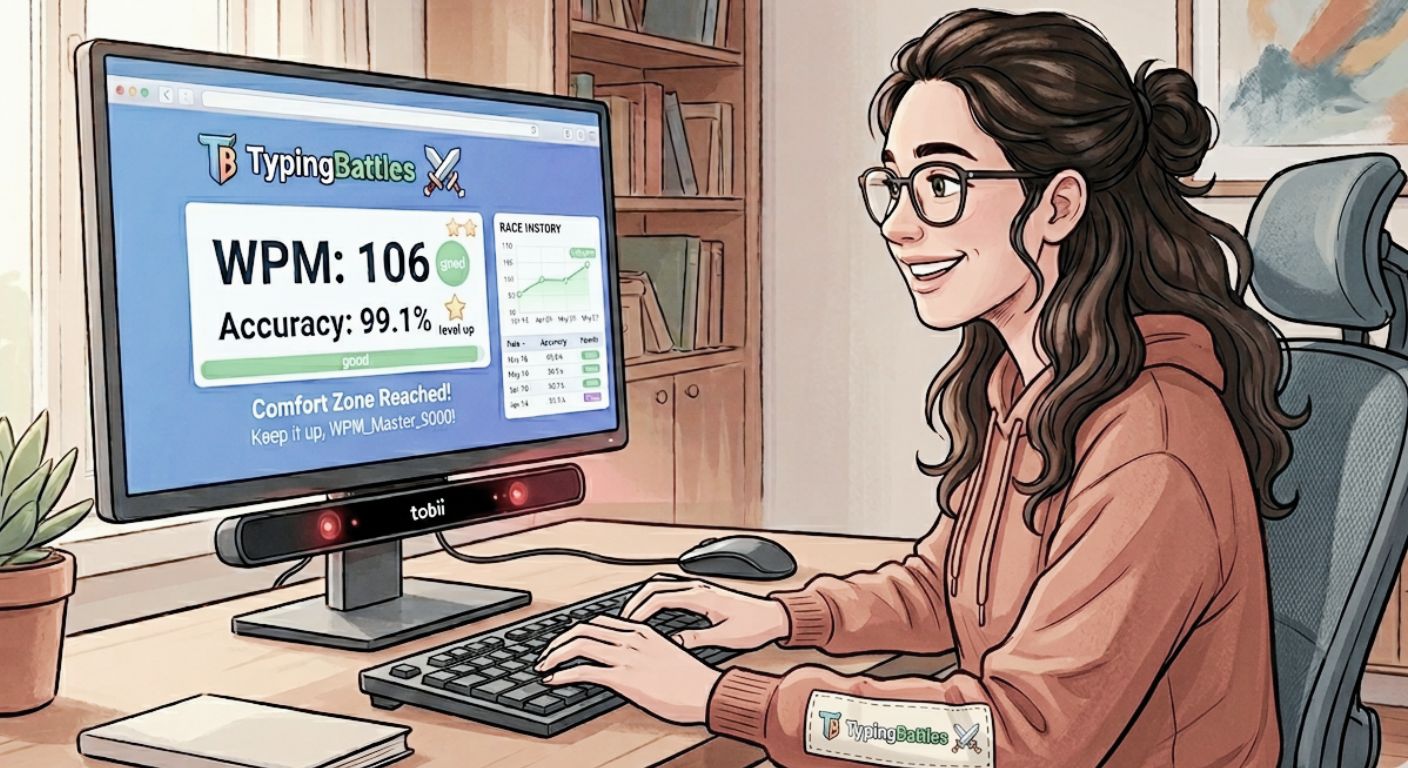
I'm at my happy level at 100 WPM. I can run as fast as a race. I can be accurate enough to write. I'm not crazy about speeding up anymore.
The true answer to the question "what is a good typing speed? It's the speed at which you're not thinking about your fingers anymore, and you're thinking about your words.
Key Takeaways
- The average typing speed is 40-45 WPM. Good is a matter of intentions.
- 20+ WPM without looking is a success for the beginner.
- Office skills 50-60 WPM and 95% accuracy are good.
- A speed of 60-85 WPM might be needed then for data entry or transcription.
- Competitive typing races on TypingBattles are in the 70-100+ WPM range.
- It's as important to get it right as to get it fast! A typographical error loses rhythm.
- The speed you're running is not a set speed. Practice changes it.
- The fastest "good" rate is the one that you don't have to think about typing at.
Author Bio
Abid is a competitive typist on TypingBattles (112 WPM peak, 400+ wins). He spent years wondering if his speed was "good enough." Now he knows it's plenty. He still gets destroyed by 140 WPM typists sometimes. He's made peace with it.
Recommendation
Stop wondering. Start typing.
Take a typing speed test to get your baseline. Then race a few rounds. You'll see exactly where you stand.
And remember: good is whatever lets you stop thinking about your fingers.
Take the test now →
Read Also:
- Typing.com Review: The Free School Typing Platform That Everyone Knows (But Should You Use It?)
- Typing Test Certificate: Do You Really Need One for Your Resume?
- Alphabet Typing Test: What It Is And The Need Of It For The Beginners
- Which Is The Best Typing Test: 1 Minute, 3 Minute Or 5 Minute Typing Test?
- Typing Nitro Hack vs Eye Gaze Typing: Cheaters Never Win, But Eye Gaze Typing Changes Lives